Showing posts with label Nature Study. Show all posts

Monday, December 22, 2014

The Nature Notebook, A Treasury of Memories


"As soon as he is able to keep it himself, a nature-diary is a source of delight to a child. Every day's walk gives him something to enter: three squirrels in a larch tree, a jay flying across such a field, a caterpillar climbing up a nettle, a snail eating a cabbage leaf, a spider dropping suddenly to the ground, where he found ground ivy, how it was growing and what plants were growing with it, how bindweed or ivy manages to climb.  Innumerable matters to record occur to the intelligent child."

The plants and trees have gone to sleep for the winter, but there was still such beauty to see on our nature walk.  A Hawthorn tree devoid of leaves revealed its long sharp thorns and bright red berries hanging from every branch.  It brought our minds to the crown of thorns our Savior wore as he hung on the cross and the berries a reminder of the blood shed for the sins of the world.  We were enchanted by the Spanish moss hanging from the leafless branches on a Live Oak tree.  On closer inspection we found Oakmoss lichen with its stringy hairs and blue green flakes covering many of the branches.  It was delightful sharing this nature study with friends as we explored the river under the bridge. We brought home a specimen, a piece of a branch from the Live Oak tree and plenty of memories of all we did and saw together.


On another day we pulled out our nature notebooks from the bookcase with all of our paints and brushes to record our nature walk.  Our jeweler's loupe allows us to see our specimen magnified 5x's.  I referred to my Handbook of Nature Study (HONS) by Anna Comstock to see what I could find about Spanish Moss, Lichen, and Hawthorn trees. It is a wonderful source of information, but on occasion our Texas flora and fauna are not found within its pages, so I go to the internet where I am able to identify our specimens. Did you know that Spanish moss is not a moss or a lichen? It gets all of its nutrients from sun and rainwater. On occasion a poem can be found in HONS relating to what we are studying and if we feel so inclined, add it to our nature notebook entry, but mostly it is a treasure of our memories and observations in nature.


I have chosen high quality spiral bound nature notebooks for us with heavy watercolor paper as most of our entries are painted with our paints.  Watercolor color paper seems to take the color very well allowing the colors to stand out without bleeding through to the other side of the page.  You are creating a keepsake to last a lifetime so quality is important.  We have used colored pencils, sketching pencils, watercolor crayons, and markers, but we continue to come back to the watercolor paints.  Why?  Because it allows you to take the time to really see your specimen.  You touch it with your eyes and mind in order to see every nuance of shape and hue.  You begin to know what you are painting in a way that is unique to any other observation.


The classic eight color Prang semi-moist watercolor set in the white box has been a perennial favorite and has produced beautiful colors in the paintings.  This year my sister gave me the Sakura Koi assorted water colors field sketch set for my birthday, which I have really enjoyed.  The variation in colors has allowed me a wider range to better capture the colors in nature.  It is important to have a variety of brush sizes, especially very fine tipped brushes, in order to paint fine detail.  Lately, we have experimented with aqua brushes that have the water in the handle. My boy used one in the picture above, but it was harder for him to control the amount of water.  What often results from excess water is a very washed out picture with little detail.  Below, I used conventional brushes, blending the colors in the pallet, and was able to paint a much more detailed picture.


Each year marches on with rapidly increasing speed, but these precious moments shared in the exploration and observation of God's beautiful creation with each other, will remain in your nature notebooks, captured and preserved.


Monday, September 1, 2014

The Privilege of Homeschooling the Charlotte Mason Way

As a homeschool educator I have the privilege to witness things that most parents miss with their children at school and I am very grateful for the opportunity.  This week was our first week back after summer break and I would like to share some observations from our week.

When we listened to Igor Stravinsky’s ballet, Firebird, and he listened to the story, I saw my son’s imagination take flight as he played out parts of the story and then he created a new story.

Dull textbooks, busy work, or worksheets have no part in my child’s education.  Instead he is presented with a wide variety of living books with vital ideas written by authors who are passionate about their subjects. His science book is Fabre’s Storybook of Science. This week’s readings sparked an intense interest in pearls and the ocean.  He was fascinated by mollusks, the slimy creature in its shell that would form a protective crystalline coating, nacre, around an irritant and the pearl divers that risked their lives in the days of old, to get them.  We watched a video I found on YouTube about the unique and rare Sea of Cortez pearls and were mesmerized by the beautiful array of colors in pink, blue, purple, green, silver and black.  I pulled out my big bag of shells and we looked at the different shades of mother of pearl and sorted them by their attributes.  It created a desire in him to see the ocean and feel the sand under his feet as he searches out shells.  Yes, there will be a trip to the shore in the near future.

Then nature study happened quite by surprise, while walking home from the neighbor’s house, he found a toad and captured it.   What a joy to observe his desire to care for the toad properly so that he may observe it.  He got out his book, Pets in a Jar, by Seymour Simon to learn about what it ate and how to care for it.  We found his toad on the internet and learned his Latin and common name.  Each day he searched out morsels for his toad, Robert, to eat such as worms and even a baby gecko.  I did cringe a bit at the gecko, but Robert ate it.  Everything was meticulously recorded in his nature notebook, first by carefully painting a picture, working to match the color properly with watercolor paints.  Then, he recorded everything that happened, being sure to include the Latin name, Bufo speciousus, and common name, Texas Toad as well.  I was there to watch his pleasure and satisfaction in a job well done.

While reading in his history books, This Country of Ours by H.E. Marshall, George Washington’s World by Genevieve Foster, and Abigail Adams: Witness to a Revolution by Natalie Bober, I witnessed his growing understanding of the cost of war in lives, property, and civilization.  He is learning that our freedom was bought with a high price and what happens on our shores or in foreign lands, has a global impact.  He is coming to know that what happened in the past affects the present.

Through his citizenship book, Plutarch’s Lives, he can see that the character of a man can have an impact on others for good and evil. Through our grand conversations I see how he is taking in these ideas and it is growing his character.  We have the opportunity live out our faith by applying what we are reading in the Bible to our lives all day, every day.

We study artists, geography, Latin, grammar, foreign language; we read poetry from the best poets, literature with rich vocabulary and has stood the test of time, Shakespeare, and sing songs.    Every day I see him drink from the feast of knowledge that I present to him and it has created an even greater hunger to know.  I am a witness to how the ideas presented by the best artists, authors, creation, and Creator are shaping his character and equipping him to think for himself, to take in what he needs or what is right and reject the rest.  It is truly a privilege and an honor that I wish every parent could have.

Sunday, May 20, 2012

Nature Study Comes Knocking on the Window

Nature study can happen in the most unexpected ways.  A snail oozing across the window sparked questions and investigation.  We pull out our jewelers loupes to look at it under 5x magnification.  Did you know the eyes are on their retractable antennae?  "Are snails born with shells?" he asks.  A quick internet search turns up the surprising answer, "Yes," and gives us more fascinating information.


Thursday, May 10, 2012

Is nature study enough science in the younger years?


"Of the teaching of Natural Philosophy, I will only remind the reader of what was said in an earlier chapter––that there is no part of a child's education more important than that he should lay, by his own observation, a wide basis of facts towards scientific knowledge in the future. He must live hours daily in the open air, and, as far as possible, in the country; must look and touch and listen; must be quick to note, consciously, every peculiarity of habit or structure, in beast, bird, or insect; the manner of growth and fructification of every plant. He must be accustomed to ask why––Why does the wind blow? Why does the river flow? Why is a leaf-bud sticky? And do not hurry to answer his questions for him; let him think his difficulties out so far as his small experience will carry him. Above all, when you come to the rescue, let it not be in the 'cut and dried' formula of some miserable little text-book; let him have all the insight available and you will find that on many scientific questions the child may be brought at once to the level of modern thought." Charlotte Mason-vol 1 pg 265

Do you remember when you were in 4th grade?  Do you remember your fourth grade science textbook with fond memories because you gleaned so much knowledge from it?  Most likely you do not remember any of your textbooks fondly because they dryly dispensed facts the curriculum writers thought you should know at each grade level.  So when we ask, “Is nature study enough?’  what we are really asking is, “Is the real study of the biological world in its actual context enough science?”  We have been so conditioned to think that learning is what is done in a classroom at a desk with text books, that when we are faced with the simplicity of really doing science, it does not seem adequate or real.

Charlotte Mason encourages a paradigm shift from using the abstract dry form of dispensing filtered knowledge in a textbook and children dutifully memorizing this information to experiencing the real thing through the actual study of nature where children learn from their own observations.   Nature study IS the foundation of science.  It is what drives the child toward a curious investigation of the world God created and it gives children a passion for science in the later years.  A child that has never observed a frog first hand or studied fungus in its natural environment will never wonder why frogs are found in or near ponds or why fungus grows in our yards?  There will be no further passion to experiment to find out how things work or why they do.  They won’t be driven by their curiosity to seek out those answers.

Living books that bring the natural world alive by writers that are passionate about their subject, undergird the study of nature.  James Herriot's Treasury for Children by James Herriot, The Burgess Bird Book for Children or The Burgess Animal Book by Thornton Burgess, Secrets of the Woods by William J. Long, Madam How and Lady Why by Charles Kingsley are read in the younger years.   These writers draw their readers into the natural world in such a way that the reader connects with it on a personal level.  Later, the children read biographies of the people who have made a significant impact in the field of science such as Albert Einstein, Isaac Newton, Alexander Graham Bell, and George Washington, Carver.

The Handbook of Nature Study by Anna Botsford Comstock is a necessity for the teacher.  This resource will help you in girding up your knowledge and it gives great nature study ideas.  Include some field guides to help identify what you find on your nature walks.

Nature Notebooks allow the child to hone his observation skills as he attempts to reproduce a subject from nature that has been studied, through drawing or painting.  As the child gets older he will include narrations of the study as well.  The nature notebook is not a field guide with dry facts about the subject.  It is a living expression of the nature study itself in which the child recounts what happened or what was seen on the nature walk.

To answer the question, “Is nature study enough in the younger years,” I would say no.  Round out your study with living books about nature, field guides, The Hand book of nature for the teacher, and sufficient time working in a nature notebook every week.  Get them outdoors often, every day if possible.  This is the solid foundation to build a science education on which will give your child the passion and tools for a lifelong love of science and learning!

Wednesday, April 18, 2012

Build It and They Will Come


After an early morning visit from a Blue Jay, this little guy wanted some of that yummy seed hanging from the top of this window. We are shocked at how brave he was. He came back several times during the day. One time he made an attempt at climbing up the window with his claws, to no avail. For his efforts we left him a little seed on the window sill. Nature study just got a little easier!

Tuesday, April 17, 2012

Heeeeere Birdie, Birdie, Birdie


With his Cub Scout pocket knife, a water jug, scissors, and a piece of string my MacGyver made this little enticement to our feathered friends. The window hook was purchased at Walmart for a few dollars. Nature study can be brought right up to your window. Now, if only the birds would come! Heeeere Birdie, Birdie, Birdie!

Tuesday, April 10, 2012

An Exciting Disruption


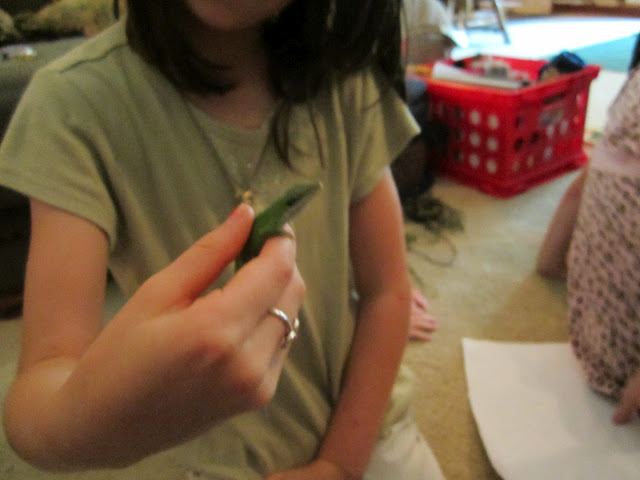
With squeals of delight the children could hardly contain themselves as they had to patiently wait their turn to hold the anole lizard that had gotten into the house.

"...a love of Nature, implanted so early that it will seem to them hereafter to have been born in them, will enrich their lives with pure interests, absorbing pursuits, health, and good humour." Charlotte Mason Vol. 1 pg. 72


When children are regularly exposed to the study of nature from and early age an amazing thing happens. They cannot help but be curious about the plants and creatures in it. Every bug is a new discovery to be examined. A bird song is heard and the child quickly scans the trees to find the bird who is singing. Flowers and mushrooms find their way into the house for display. Each discovery is a treasure!
Blogger Wordpress Gadgets