Showing posts with label Education. Show all posts

Friday, May 13, 2016

How do I know when my child is ready to read?

A very long time ago I entered kindergarten as a four year old who would turn five that October.  In hindsight, which is always 20/20, I was far too young and not ready on many levels.  I was very immature and was not developmentally ready.  My mom worried too, but they assured her that there was a reading readiness class between kindergarten and first grade if I needed it.  The consequences of beginning school too soon negatively impacted the rest of my school education.

I have vivid memories of kindergarten.  There were centers set up around the room we could rotate through.  I remember playing house in the kitchen and the  big cardboard blocks the boys liked to build with.  There were puzzles, the memory game and lacing cards.  I remember playing with clay and cutting with safety scissors with rounded tips.  We had story time and singing and dancing.  Every day we played outside on the playground quite a bit and took naps, even in my half day class. We were taught the alphabet and to count to twenty, but the one thing we never were taught was how to read.

All those years ago in the early 1070's, the teachers knew something that we have forgotten today.  They knew that children needed to be ready to learn to read and there were physiological signs that indicated readiness.  Reading was never taught in kindergarten or earlier because the majority of children are not physiologically ready to read until, at the very least, age six and for some children it is later.  My kindergarten and first grade classrooms had balance beams in them.  Why?  Because children who are ready to read can walk on a balance beam without falling off.  I remember my first grade teacher requiring her students to skip and jump rope.  She was looking for the students to be able to skip with opposite hands and feet extended with smooth, flowing movements.  Today we know from modern neurological research that reading requires both hemispheres, the right for the spatial sight words and the left for phonetic decoding.  The Corpus Callosum, the neurological bridge between the two hemispheres that allows bilateral movement, is not developed enough for reading and writing until around age six or seven.  In some children it doesn’t develop until age ten or eleven.

Teaching a child to read before the bilateral pathways have developed can cause lifelong reading disabilities.  Remember that reading is a bilateral activity for the brain.  If the Corpus Callosum is not developed enough then signals cannot travel between the two hemispheres and only one side, the right side which is responsible for sight words,  must do all the work of reading.  The majority of reading must be done by decoding, but cannot be accessed.  For some children who have been trained to read this way, they will continue to access the right hemisphere only when the Corpus Callosum eventually develops.  Math as well requires both hemispheres which may be why so many children struggle with it in the early years.

It is the gross motor movements of the body that develop the neural pathways necessary for reading, writing and spelling.  Think about the untold hours children before the age of six spend sitting in front of a screen.  Their bodies and minds are disengaged from the real growth their neurology and body needs.  Provide your child with plenty of outdoor time running, jumping, spinning, climbing, swinging, riding a bike, throwing a ball, etc.  Your child needs hours and hours of gross motor movement every single day.

There are signs you can look for that will indicate that your child is ready for formal education, and more specifically, to read and write.  Can your child skip, jump rope with an added hop between jumps, walk on a balance beam or log without falling off, ride a bike or stand on one foot with arms out to the sides with eyes closed for a prolonged amount of time?  These are all indicators of the integration of the bilateral pathways.

What if your child is not ready by age 6 or 7 or 8 or 9 years old?  What if they are 10 or 11 years old and still cannot read?  Do not panic!   For these children it is perfectly NORMAL and something that should not concern you.  Your child will learn to read when the neural pathways develop.  You will need to read all of your children’s school books to them during this time and hold off on writing.  If you have a positive attitude of acceptance, your child will not think it abnormal and feel like a failure.  Do not attempt to teach them to read until they show the physiological signs that there is bilateral integration.  In the meantime, offer your child plenty of time each day for gross motor activities.  Bilateral activities like Taekwondo, Bal-A-Vis-X, basketball, soccer, etc. will all help.  The good news is that the late bloomers will catch up with their peers very quickly.  For some children it will only take a matter of months.

If your child shows the physiological signs of reading readiness and they are still unable to learn to read, then there may be a reading disability that needs further investigation, but I suspect that there will be very few of those indeed.  It is this teacher’s opinion that early reading education before a child is ready, has caused the majority of the learning disabilities we see today.

If you would like to learn more about this topic go to the website below.  It is written by a Behavioral and Developmental Pediatrician who has been working in the field for 27 years and contains an abundance of helpful information.

http://www.youandyourchildshealth.org/youandyourchildshealth/articles/teaching%20our%20children.html

Thursday, June 13, 2013

The Mathematics Curriculum: Should it Stay or Should it Go?

“I don’t like the math curriculum we are using.  Which curriculum would you recommend?”

Having taught mathematics in the public schools, I get this question every year.  I am sharing my thoughts on this topic to give you a perspective you may not have considered in the past.  When you hear a fellow homeschooling friend rave about the math program she is using in her homeschool, a lot of us can’t help having order envy.  Maybe we would be a lot happier doing math with that curriculum instead.  As a result many end up tossing over their current curriculum only to find that the grass was no green on this side of the fence.  This cycle may continue to perpetuate itself because you are looking for something that does not exist.

Every mathematics program has a scope and sequence or an outline of skills and information to be taught, organized by grade level.  If you switch the curriculum from year to year the unavoidable consequence is that your children will have gaps, concepts they did not master but should have, in their mathematics education.  The more often you switch the curriculum, the bigger and vaster the gaps.  As a result of these gaps, it is a lot harder for them to understand the more difficult concepts in the later years because they have not mastered the necessary foundational concepts needed.

My recommendation would be to stick with what you have.  I cannot stress enough persevering with a curriculum so that your children are taught all of the concepts they need, when they need them.  The bottom line is that there is no mathematics curriculum available that makes you want to cheer with excitement.  Yes, there are different types of mathematics programs, but ultimately math is math; the concepts to be taught are absolute.  2+2 will always equal 4 regardless of the curriculum.  Mathematics is not thrilling to most people no matter how the curriculum company presents it, but it can be enjoyable to master new concepts that were difficult.  There is satisfaction in that.

“My child is struggling with the concepts presented in the curriculum I am currently using.  Isn’t that a good reason to switch to a different curriculum?”  

First, the beauty of homeschooling is that you are not on anyone else’s timeline.  If you need to spend much longer on a difficult concept, then you have the freedom to do that.  If you want to skip pages in a section that has been quickly mastered, then you are free to do that.

Second, the struggle to grasp new concepts is not an indication that the curriculum is not working for you. It is also not a sign of academic weakness in your child or an indication that your child is not mathematically minded.  Struggle is the means in which your child learns hard things.  A weight lifter cannot start with the heaviest weight.  He must work his way up to it by regular practice with light and then gradually heavier weights in order to build and strengthen his muscles.  It is like this with mathematics as well.  It requires frequent practice of solving math problems with gradually increasing difficulty.  As a result, your child will develop the habits of accuracy, observation, and perseverance. Each struggle strengthens the child.  There is nothing more exciting for the child who has persevered with a difficult concept to finally understand it.  There is such an overwhelming sense of relief and joy in seeing the problem through to its successful end. In the midst of your child’s struggle, if you see him begin to lose heart, remind him of that last moment of success as a means of encouragement.

“Mathematics depends upon the teacher rather than upon the text-book and few subjects are worse taught; chiefly because teachers have seldom time to give the inspiring ideas, what Coleridge calls, the 'Captain' ideas, which should quicken imagination.” 
Charlotte Mason Vol. 6 p. 233

Finally, it falls upon the teacher to present the concept to the child in a way that he can understand.  The curriculum is only a guide.  If your child does not understand the concept after you have presented it as suggested by the curriculum, then you as the mathematics teacher must find a different way to present that concept.  Mathematics was one of the subjects that Mason agreed relied heavily on the teacher and she was correct.  This may seem daunting to some, but do not let this idea stop you from being a good math teacher.  There are so many resources online, that I have full confidence that you will be able to find the help you need.  If you are part of a homeschooling network, then there are many people within who could help you as well.

I would like to encourage you to persevere with your curriculum choice.  Make it work for you.  You have chosen the hardest thing already by choosing to homeschool, you can do this too.


Look for my next post on how to choose a mathematics curriculum.

Wednesday, July 11, 2012

A Short Synopsis Of Charlotte Mason's Philosophy of Education

"No sooner doth the truth ... . .come into the soul's sight, but the soul knows her to be her first and old acquaintance."

"The consequence of truth is great; therefore the judgment of it must not be negligent." (Whichcote).


1. Children are born persons.

2. They are not born either good or bad, but with possibilities for good and for evil.

3. The principles of authority on the one hand, and of obedience on the other, are natural, necessary and fundamental; but––

4. These principles are limited by the respect due to the personality of children, which must not be encroached upon whether by the direct use of fear or love, suggestion or influence, or by undue play upon any one natural desire.

5. Therefore, we are limited to three educational instruments––the atmosphere of environment, the discipline of habit, and the presentation of living ideas. The P.N.E.U. Motto is: "Education is an atmosphere, a discipline, and a life."

6. When we say that "education is an atmosphere," we do not mean that a child should be isolated in what may be called a 'child-environment' especially adapted and prepared, but that we should take into account the educational value of his natural home atmosphere, both as regards persons and things, and should let him live freely among his proper conditions. It stultifies a child to bring down his world to the child's' level.

7. By "education is a discipline," we mean the discipline of habits, formed definitely and thoughtfully, whether habits of mind or body. Physiologists tell us of the adaptation of brain structures to habitual lines of thought, i.e., to our habits.

8. In saying that "education is a life," the need of intellectual and moral as well as of physical sustenance is implied. The mind feeds on ideas, and therefore children should have a generous curriculum.

vol 6 pg xxx

9. We hold that the child's mind is no mere sac to hold ideas; but is rather, if the figure may be allowed, a spiritual organism, with an appetite for all knowledge. This is its proper diet, with which it is prepared to deal; and which it can digest and assimilate as the body does foodstuffs.

10. Such a doctrine as e.g. the Herbartian, that the mind is a receptacle, lays the stress of education (the preparation of knowledge in enticing morsels duly ordered) upon the teacher. Children taught on this principle are in danger of receiving much teaching with little knowledge; and the teacher's axiom is,' what a child learns matters less than how he learns it."

11. But we, believing that the normal child has powers of mind which fit him to deal with all knowledge proper to him, give him a full and generous curriculum; taking care only that all knowledge offered him is vital, that is, that facts are not presented without their informing ideas. Out of this conception comes our principle that,––

12. "Education is the Science of Relations"; that is, that a child has natural relations with a vast number of things and thoughts: so we train him upon physical exercises, nature lore, handicrafts, science and art, and upon many living books, for we know that our business is not to teach him all about anything, but to help him to make valid as many as may be of––

"Those first-born affinities
"That fit our new existence to existing things."

13. In devising a SYLLABUS for a normal child, of whatever social class, three points must be considered:

(a) He requires much knowledge, for the mind needs sufficient food as much as does the body.

(b) The knowledge should be various, for sameness in mental diet does not create appetite (i.e., curiosity)

(c) Knowledge should be communicated in well-chosen language, because his attention responds naturally to what is conveyed in literary form.

14. As knowledge is not assimilated until it is reproduced, children should 'tell back' after a single reading or hearing: or should write on some part of what they have read.

15. A single reading is insisted on, because children have naturally great power of attention; but this force is dissipated by the re-reading of passages, and also, by questioning, summarising. and the like. Acting upon these and some other points in the behaviour of mind, we find that the educability of children is enormously greater than has hitherto been supposed, and is but little dependent on such circumstances as heredity and environment. Nor is the accuracy of this statement limited to clever children or to children of the educated classes: thousands of children in Elementary Schools respond freely to this method, which is based on the behaviour of mind.

16. There are two guides to moral and intellectual self-management to offer to children, which we may call 'the way of the will' and 'the way of the reason.'

17. The way of the will: Children should be taught, (a) to distinguish between 'I want' and 'I will.' (b) That the way to will effectively is to turn our thoughts from that which we desire but do not will. (c) That the best way to turn our thoughts is to think of or do some quite different thing, entertaining or interesting. (d) That after a little rest in this way, the will returns to its work with new vigour. (This adjunct of the will is familiar to us as diversion, whose office it is to ease us for a time from will effort, that we may 'will' again with added power. The use of suggestion as an aid to the will is to be deprecated, as tending to stultify and stereotype character, It would seem that spontaneity is a condition of development, and that human nature needs the discipline of failure as well as of success.)

18. The way of reason: We teach children, too, not to 'lean (too confidently) to their own understanding'; because the function of reason is to give logical demonstration (a) of mathematical truth, (b) of an initial idea, accepted by the will. In the former case, reason is, practically, an infallible guide, but in the latter, it is not always a safe one; for, whether that idea be right or wrong, reason will confirm it by irrefragable proofs.

19. Therefore, children should be taught, as they become mature enough to understand such teaching, that the chief responsibility which rests on them as persons is the acceptance or rejection of ideas. To help them in this choice we give them principles of conduct, and a wide range of the knowledge fitted to them. These principles should save children from some of the loose thinking and heedless action which cause most of us to live at a lower level than we need.

20. We allow no separation to grow up between the intellectual and 'spiritual' life of children, but teach them that the Divine Spirit has constant access to their spirits, and is their Continual Helper in all the interests, duties and joys of life.

Saturday, June 2, 2012

Shouldn’t a child’s education include lots of science experiments?


“No-eyes come home bored; he has seen nothing, been interested in nothing: while Eyes is all agog to discuss a hundred things that have interested him. As I have already tried to point out, to get this sort of instruction for himself is simply the nature of a child: the business of the parent is to afford him abundant and varied opportunities, and to direct his observations, so that, knowing little of the principles of scientific classification, he is, unconsciously, furnishing himself with the materials for such classification. It is needless to repeat what has already been said on this subject; but, indeed, the future of the man or woman depends very largely on the store of real knowledge gathered, and the habits of intelligent observation acquired, by the child. ” Charlotte Mason vol 1 pg 265

I loved my high school chemistry class with all of its experiments and chemical formulas.  I knew this was the career path I wanted to take.  I entered my university with the intention of getting a degree in Chemistry.  What I found out midway through was that I loved teaching more.  I graduated with a Bachelors of Science and a teaching degree with a science major and math minor.  I did lots of experiments with my students…or so I thought.

All of us were taught the scientific method whether we remember it or not.

Scientific Method
Observation/Research
Hypothesis
Prediction
Experimentation
Conclusion

Did you notice where the scientific method begins?  It starts with observation and research of the natural world, nature study!  It is the foundation.  This is the missing link in traditional education.  The rest of the method flows from that.  You cannot have a scientific method if you do not have its starting point.  In my previous post “Is nature study enough in the younger years?” I explained that nature study is the starting point of all real science.  If you haven’t read it, please do.

You probably have at least one experiment book on your shelf.  You can thumb through it to pick out an experiment for your study of sound or motion.  The experiment would then provide the hypothesis, the steps for the experiment and then it will draw the conclusion for you or tell the student why it works.  This is somebody else using the scientific method to create an experiment.  Somebody else has already drawn the conclusions for the child. The student is just copying somebody else’s preprocessed information, very much like following a recipe.  This is not a science experiment.  What your child has learned to do is follow directions but there is very little real science in this, it is instead another form of dispensing knowledge.

Wouldn’t it be better for the child to actually do the scientific investigation himself?  How does this look?  Let’s look at example of a child directed experiment that took place in my home.

Observation and Research
Caleb noticed a potato in the pantry had sprouted eyes and he wanted to know what they were and why they were there.  I explained what the eyes of the potato were and that if you cut them off with some of the potato they would grow.

Hypothesis
“I am going to plant it in the pot,” he said.
“If you plant one in the garden as well, which one do you think would grow better?” I asked.

Prediction
“I think the one in the garden will because it has more space for the roots and better soil to grow in,” he predicted.  

Experimentation
He planted potato eyes in both places.  He kept his potatoes well watered and watched them grow.

Conclusion
He found that the potted potato, although it grew faster, did not get very big. The potatoes from this plant were small.  His garden plant took longer to grow and yielded a much bigger plant with bigger potatoes.

Nothing was written down and no display board was made.  It was very natural and informal, but each step in the method was there.  Not all of his investigations include every step in the scientific method and that is acceptable.  We have also done experiments out of one of our experiment books in the past.  Do you think he remembers them?  No, because there was nothing for him to connect to the information.  A fun experiment copied from a book is not enough for a child to connect to the ideas and concepts.  In contrast, he will always remember his potato experiment.  Later, when he learns about plant adaptations, he will have an experiential understanding to the concept.

God has created a beautiful world for us to live in.  He has also created us in His image, special in His creation.  He has given us a desire to know Him.  The study and investigation of His creation gives us a peak into the nature and character of our Creator.  A child’s education should include scientific investigation but not in the way we have been conditioned to think of science experiments.  Let his investigations be an expression of the child’s own observations of nature and his natural curiosity.  Then he will be furnished with a storehouse of real knowledge gathered, and the habits of intelligent observation acquired.

Wednesday, May 2, 2012

Ambleside Online is Not Structured Enough?


When I tell people that I am using the Charlotte Mason curriculum Ambleside Online for my homeschool the response is often, “I have looked into it once but was overwhelmed.  I need something that is much more structured.”  I understand why one would feel that way.  When you go the Ambleside Online website, you can easily become overwhelmed when looking at the long list of weekly readings.  It is hard for many to imagine how that list can become what you traditionally thought of as school.  What many people do not know is that there are organized schedules that you can download for free.

The school year is 36 weeks which is divided into three 12 week terms.  The term schedules break down the books into weekly readings by chapter.  The schedule below is the one we are currently working from.  This is one of six pages.  Once you have downloaded it, the schedule is fully editable.  You simply fill it in with your math curriculum and so forth.  This is the schedule from Judy Elliot, which I use to make my weekly lesson plans from.  So don’t get stymied by the website.  There is an easier more structured format!  You can find the files on the AO HEO Schedules Yahoo Group.  Simply join the group to gain access to the schedules you will need to implement the curriculum.


Monday, April 16, 2012

Why British History First?


A Storehouse of Ideas
Much that has been said about the teaching of geography applies equally to that of history. Here, too, is a subject which should be to the child an inexhaustible storehouse of ideas, should enrich the chambers of his House Beautiful with a thousand tableaux, pathetic and heroic, and should form in him, insensibly, principles whereby he will hereafter judge of the behaviour of nations, and will rule his own conduct as one of a nation.  Charlotte Mason

When I had made the decision to use the Ambleside Online Curriculum, in our homeschool I was a little baffled by the choice of this particular British history book by H.E. Marshall starting in Year 1.  In all of my education experience we had only studied American history in elementary school.  It made sense to me that we would first study the country we live in.  Fortunately, my good friend June explained the importance of studying British history.  Our country started out as colonies of England.  I don't know why I never thought about this.  Of course I knew the first pilgrim colony consisted of English men, women and Children.  The events in England effected events in our country and profoundly effected the founding fathers.  If you know British history you better understand why a small group of people came to start our country, leaving everything familiar willing to brave untold hardships.  Understanding British history provides the context for our country's history.  Marshall's book is captivating and brings the past to life.  History becomes the context for artists, musicians, poets, and writers of literature who lived during this time as well.  What was happening in the church and government and the ideas of the time where communicated by the artists, musicians, and writers.  Therefore, students who study the art, music, poetry and literature during that time are able to naturally make connections.

The mistake we make is to suppose that imagination is fed by nature, or that it works on the insipid diet of children's storybooks.  Let a child have the meat he requires in his history readings, and in the literature which naturally gathers round this history, and imagination will bestir itself without any help of ours; the child will live out in detail a thousand scenes of which he only gets the merest hint.  Charlotte Mason  

Tuesday, April 10, 2012

An Exciting Disruption


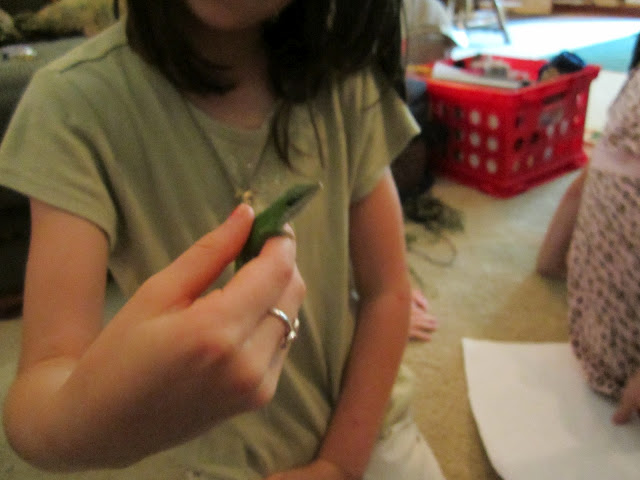
With squeals of delight the children could hardly contain themselves as they had to patiently wait their turn to hold the anole lizard that had gotten into the house.

"...a love of Nature, implanted so early that it will seem to them hereafter to have been born in them, will enrich their lives with pure interests, absorbing pursuits, health, and good humour." Charlotte Mason Vol. 1 pg. 72


When children are regularly exposed to the study of nature from and early age an amazing thing happens. They cannot help but be curious about the plants and creatures in it. Every bug is a new discovery to be examined. A bird song is heard and the child quickly scans the trees to find the bird who is singing. Flowers and mushrooms find their way into the house for display. Each discovery is a treasure!

"...a love of Nature, implanted so early that it will seem to them hereafter to have been born in them, will enrich their lives with pure interests, absorbing pursuits, health, and good humour." Charlotte Mason Vol. 1 pg. 72


When children are regularly exposed to the study of nature from and early age an amazing thing happens. They cannot help but be curious about the plants and creatures in it. Every bug is a new discovery to be examined. A bird song is heard and the child quickly scans the trees to find the bird who is singing. Flowers and mushrooms find their way into the house for display. Each discovery is a treasure!

Wednesday, August 3, 2011

Who is Charlotte Mason?

Charlotte Mason (1842-1923) was a British educator whose philosophy of education so accurately described how children learn naturally that it has withstood the test of time and is as relevant in our day as it was in hers.  She believed that children where persons capable of intelligent independent thought, in contrast to the common belief that children were blank slates to be written on by the teacher or an empty bucket to be filled with knowledge.  Mason believed, and I think correctly, that children are born persons with abilities, dispositions with the power of independent thought.  They need vital ideas to feed their growing minds rather than dry facts.  Rather than the teacher becoming the middle man dispensing filtered knowledge to the child, the child should do the work of dealing with the ideas and making connections.  Mason believed that education is “…an atmosphere, a discipline, a life.”  It is about finding out how we fit into this universe that God has created for us.  Her philosophy of education has revolutionized thought on how children learn and therefore should be educated.  You can read Charlotte Mason's Original Homeschooling Series at http://www.amblesideonline.org/CM/toc.html.  
Blogger Wordpress Gadgets